Jul 02, 2026 By Team YoungWonks *
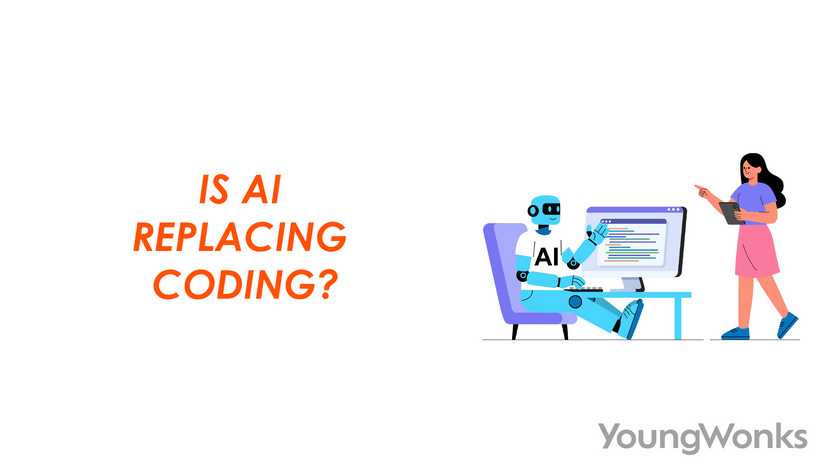
If you've typed a question into ChatGPT and watched it generate a working Python script in seconds, it's natural to wonder: does my kid still need to learn how to code? It's a fair question, and one that a lot of parents, students, and even seasoned software engineers are asking right now. The headlines don't help either. Between layoffs at major tech companies and the rapid rise of generative AI, the hype around AI replacing programmers has never been louder.
But here's the thing: the future of coding with AI isn't a story about replacement. It's a story about supercharging. And the kids who understand the fundamentals today are exactly the ones who will thrive tomorrow.
AI Is a Coding Collaborator, Not a Replacement
Think of AI tools the way you'd think of a powerful calculator. A calculator doesn't make math education pointless; it makes it faster. But you still need to understand what you're calculating and why. The same logic applies to coding with artificial intelligence.
Tools like ChatGPT, Claude, and GitHub Copilot are genuinely changing how software development works, as are AI-native development environments like Cursor and Claude Code that integrate AI assistance directly into how code is written and reviewed. (A note on the landscape: ChatGPT and Claude are currently the most widely used, with Copilot's dominance tapering as Microsoft has shifted significant investment toward OpenAI.) Developers today use these tools to generate boilerplate code, autocomplete functions, handle optimization tasks, and speed up workflows that used to take hours. The numbers back this up: research shows developers using AI coding tools complete tasks up to 55% faster, and AI-generated code has become a normal part of how products get built across startups and enterprise teams alike.
Here's the more nuanced truth, though: these tools are genuinely impressive at breaking down a problem, suggesting an approach, and generating code that often looks right. They do demonstrate what functions, in many cases, like real understanding. But "looks right" and "is right" are two different things, and that gap is exactly where human coding knowledge becomes irreplaceable.
The more precisely you understand what an AI is generating, the better you can direct it and the better your results will be. When AI gets stuck, and it does, sometimes in frustrating loops on what should be simple fixes, a programmer needs to step in with a manual correction to move things forward. Without that ability, the AI just keeps circling. And most importantly, translating AI output into real-world outcomes that actually work in a specific context still requires a human who understands what the code is doing and why.
This is why learning to write code from scratch still matters. When a young coder understands variables, loops, functions, and logic, they're not just learning syntax. They're building the mental framework to direct AI tools effectively, catch errors before they compound, and ultimately build things that actually work. Without that foundation, AI assistance quickly becomes AI confusion.
The Skills That Matter Most in an AI-Enhanced World
So what does the job market actually reward today? Across computer science, web development, and software engineering, the skills that consistently create value are the ones that remain genuinely hard for AI to replicate reliably: real-world problem-solving, critical judgment, and debugging under pressure.
AI is actively being used for all three of these, and that's worth acknowledging honestly. It does debugging impressively well in many cases. But it also gets stuck, and occasionally goes completely off the rails in ways that take real expertise to untangle. Academic researchers are using AI to generate and refine ideas. Product teams are shipping AI-assisted code at scale. The difference between those outcomes going well and going badly almost always comes down to whether a skilled human is in the loop, able to evaluate, redirect, and fix what the AI produces.
Real-world application is where this gap shows up most clearly. AI can write a function. It struggles, more often than not, to understand the full context of what a business actually needs, what constraints exist, and what the consequences of a wrong answer are. That judgment still belongs to the programmer.
As Vishal, Founder of YoungWonks, notes in a recent post, Early Exposure to AI can do more harm than good, turning it into a crutch rather than a tool. Backed by classroom experience and emerging research, he highlights how over-reliance on AI can weaken critical thinking and erode foundational skills. The reminder is an important one: AI can accelerate learning, but it cannot replace the need to first learn how to think.
It's also worth being clear-eyed about what the job market will look like. The total number of entry-level coding roles may shift as AI handles more routine tasks. But the programmers who started young, built strong fundamentals, and learned to work intelligently with AI tools will be in extremely high demand, and extremely well compensated. The future belongs to superstar programmers who understand the technology deeply enough to push it further than it can go alone.
What Coding Education Looks Like Alongside AI (and Why Sequence Matters)
Here's something worth understanding about how coding education should work in an AI-enhanced world: sequence matters enormously.
At YoungWonks, students aren't introduced to AI coding tools until after Level 4. That's intentional. Before a student ever works with AI-assisted development, they've already built a strong foundation in core programming languages and frameworks. They understand how to structure a program, how to think through logic, and how to debug their own work.
Up through Level 4, classwork and homework are done without AI assistance. That isn't a limitation; it's the point. It's how students build the internal model of how code works that makes everything that follows more powerful. Where AI does enter the picture earlier is in project fairs and internal competitions, where students who are legally permitted to use it can begin applying AI as a genuine building tool. In that context, the results are striking: a student who understands the fundamentals can now go well beyond a single prototype. They can iterate quickly, test multiple approaches, and arrive at outcomes that would have taken months of solo work before. The combination of a strong foundation and smart AI use is genuinely multiplicative.
By the time AI tools fully enter a student's workflow, they're not intimidated by them. They know how to evaluate, direct, and improve what AI produces. They can look at AI-generated code and ask: is this actually right? Does this solve the real problem? Can I refactor this to make it better?
This is very different from jumping straight into AI-assisted coding without the groundwork. When students skip the fundamentals, they often can't tell good code from bad code. They become dependent on tools they don't understand, a pattern that senior engineers have flagged as a real concern: AI can produce code, but it's not always maintainable or reusable without human oversight. The goal at YoungWonks isn't just to teach kids to code today; it's to build programmers who can upskill continuously as the field evolves.
And the field is evolving fast. Machine learning, automation, and AI-driven development are creating entirely new jobs that didn't exist last year. According to the World Economic Forum's Future of Jobs Report, technology-related roles are the fastest-growing jobs in percentage terms, including AI and machine learning specialists and software and application developers. The demand for people who can work intelligently with AI tools, understand software development at a foundational level, and apply critical thinking to complex problems is only growing.
Anthropic, OpenAI, and other leading AI labs are building increasingly powerful models, but even their own researchers emphasize that human oversight, contextual judgment, and creative problem-solving remain irreplaceable for complex, real-world development tasks. The future of software engineering isn't humans versus AI; it's humans who understand AI leading the way.
The Future Belongs to Kids Who Start Now
The question isn't whether AI will change coding. It already has. The real question is whether young programmers will be equipped to lead that change or just follow it.
The kids who learn problem-solving, master the fundamentals, and understand how to use AI as a collaborator rather than a crutch are the ones who will build the next generation of startups, tools, and technologies. They'll be the programmers that teams rely on, not because they avoided AI, but because they understand it deeply enough to use it well. And with AI as a co-builder, the scope of what a young programmer can create is larger than it has ever been.
The future of coding with AI is genuinely exciting, and it starts with giving kids the right foundation early. If you're thinking about where your child begins that journey, there's no better time than now.
Interested in how YoungWonks builds real coding skills from the ground up? Start your child's journey with YoungWonks, where every learner begins at Level 1 to build a strong foundation before progressing step by step. Explore the program here.
*Contributors: Written by Yamini ; Lead image by Shivendra Singh